
.png)


.jpg)
.jpg)
.jpg)


Medium-bores can still perform admirably in a modern world.
Dave Dye and Boddington with a good Alaskan brown bear, taken with a .338 Win Mag with 250-grain bullets. Even the fastest .33s aren’t generous for the largest bears, but they get the job done.
By Craig Boddington
So many cartridges. So little popularity, yet so much utility. When I think “medium,” I’m thinking cartridges over .30 in bullet diameter, less than .375. My definition, not Gospel. The Brits considered .30 and under small-bores. Mediums went on up to .400. In the early 1900s, this got confused with new cartridges like the .404 Jeffery and .416 Rigby. John Taylor (African Rifles and Cartridges) termed these “large mediums;” big-bores were .450 and larger.
I like stopping medium at about .375. The .375 H&H is street-legal and proven on the largest game in all African jurisdictions. Few American hunters have need for pachyderm pounders, but we do have game bigger and tougher than deer: Elk, moose, all the bears, extra-large hogs. Depending on velocity and shooting distances, the mediums shine in this arena.

From the blackpowder era to today there have been dozens of medium-caliber cartridges. American, British, European metrics. Bullet diameters have been limited: .32 (8mm); .33, .35 (all with multiple specific diameters), plus the European 9.3mm (.366).
Over here, I can only think of a half-dozen that have had lasting popularity, and several of these are disappearing. This short list would include: .38-55 (1884), initially Ballard, now Winchester, once a popular target cartridge and still loaded. .35 Remington (1906), long a deep-woods standby, no longer chambered in new rifles. The legendary .348 Win (1936), fast and powerful for tubular-magazine lever-guns. Still around but it was only chambered in the Winchester M71. .338 Win Mag (1958), never wildly popular, but a standard choice among bear, elk, and moose hunters. .35 Whelen (1989). Wildcatted in the 1920s, finally legitimized by Remington. Not a best-seller, but a hard-hitting and versatile “un-magnum” performer. 9.3x62 Mauser (1905), a worldwide standard, compact little powerhouse gaining popularity in America.
Friends at Winchester would like me to include .350 Legend (2019). So far, sales have been fantastic in “straight wall” states, and the Legend is AR-compatible. However, we consumers can be fickle, so let’s say the jury is still out on. I don’t mean to throw stones at your Old Betsy; several of my favorite mediums aren’t included. Maybe there have been too many mediums in a market where, traditionally, sales above .30-caliber drop fast.
Doesn’t matter whether my darling or yours won the popularity contest. Those of us who love mediums love them because they hit hard and make things happen. We believe in bullet weight and frontal area, and we don’t like to track. We want DRT (Down Right There), and we believe our mediums do that.
We have so many excellent old and new mediums to choose from that it’s downright confusing. I can’t mention all of them, but it seems our mediums can be divided into three velocity classes: Slow, Medium, and Fast. These are also arbitrary. We can fiddle with velocity by going up or down in bullet weight, so I mostly looked at potential based on case capacity. The primary exception is the old .38-55, which started as a black powder cartridge, thus is still loaded to original pressure.
My “slow” mediums tend to have muzzle velocity (fps) from the teens to the low 2000s. Their hallmarks are soft recoil, mild muzzle blast, arcing trajectories, and good short-range performance. Depending on bullet weight, my “medium mediums” have velocities mid to upper 2000s. They have more recoil and blast, shoot flatter, hit harder. They are not long-range cartridges but extend the range envelope. Provided you don’t over-extend that envelope, they are suited for larger game than my short-range mediums.
My “fast mediums” start in the upper 2000s and, in the largest cases (or with lighter bullets) easily break 3000. Recoil and muzzle blast are significant. These are “magnums,” whether so named or not. By African law, they are not street legal for thick-skinned game but are adequate for our largest bears. Common sense is their only range limitation. Let’s see where I think these three groups fit.
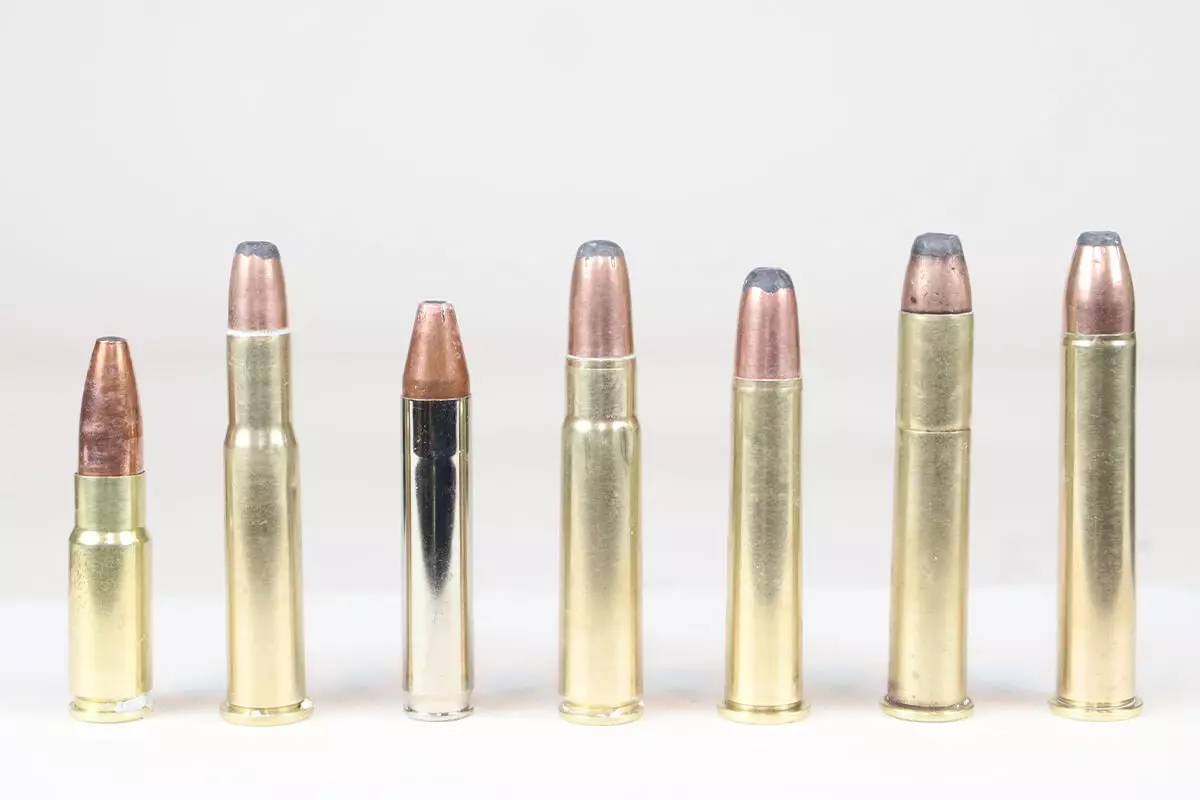
This is a huge group, some the old “brush-busting” cartridges. They don’t get through brush better than anything else but hit hard at close range, typically loaded with blunt-nosed bullets that transfer a lot of energy on impact. With rainbow trajectories and rapidly diminishing energy, they must be kept to short range. Fine deer cartridges to 150 yards, max 200. On hogs and black bears, closer is better.
In caliber, I take this group up to .38-55 and the almost-gone but hard-hitting .375 Win. Since both are “.375s,” if the regulation states “.375 minimum” they are technically legal—but inadequate—for the largest game The photo shows a lineup of good examples. Fans insist the old .32 Winchester Special hits harder than the .30-30, despite similar paper ballistics. The .338 ARC is new, but, like all mediums, frontal area deals a heavy blow. With super-heavy bullets, .338 ARC is proving effective for suppressed/subsonic use. The .350 Legend and .360 Buckhammer were developed to meet all straight-wall criteria, thus offering more accurate and flatter-shooting options than shotgun slugs.
Missing from my photo lineup is the .357 Magnum. This is because, in handguns, I consider it marginal for big game. Legal in all straight-wall states, it gains much velocity in carbine or rifle-length barrels, lagging only slightly behind .350 Legend.

