.png)


.jpg)
.jpg)
.jpg)

By Ed Cartier
If it’s February, I must be looking through one of many outfitter catalogs, figuring out how to lighten my bank account even further and use up one of the few wall spaces that doesn’t have a head, fish or piece of sporting art hanging on it. In February of 1998, Cabelas Outdoor Adventures® was promoting a mixed bag hunt for caribou, ptarmigan and salmon on the Alaskan peninsula, and I was on the phone once again with Gregg Severinson. He described it as a fly-in trip to a remote camp run by Joe Klutsch, who Gregg mentioned was a very reliable Alaskan outfitter. The hunt was for a week, and I had a good chance for a decent caribou and some outstanding salmon fishing. I was sold and booked the hunt.
As this was my first trip to Alaska, it gave me a good excuse to get some new gear. The trip list that Gregg sent specified a pack frame, “Alaskan Sneaker” rubber hip boots, a cold weather sleeping bag, a roll-up foam sleeping pad, a compressible down jacket and a mosquito head net, among other things. Packages came to the house each week, and I piled the equipment in a box, waiting for September. Over the summer, I filled my over-sized fly box with a bunch of orange and pink and purple flies, hiked at least four miles a day and got my .338 shooting tight groups. Cashing in some frequent flyer miles, I was able to secure a free seat up front, but only if I went to Alaska via Phoenix. I didn’t care as I was overnighting in Anchorage, and what’s a couple of extra hours if you don’t have to be anywhere?

If you have ever hunted the Alaskan peninsula or interior, you will know that the planes get progressively smaller as you get closer to camp. The plane that took us from Joe Klutsch’s Katmai Guides operation in King Salmon to the caribou camp was so small that it barely held the pilot, my guide Jim Doran and myself. It was so tight that we had to leave the rod cases behind and slide the rods in the spaces between the bags. The flight was a little rocky, but I didn’t get concerned until the pilot started gaining altitude to seemingly get over some 14,000-foot class mountains. There was a storm on the horizon, and I started to lose faith. At what seemed to be the last minute, he banked the plane and told me to look down. There was a sapphire-blue lake tucked in the top of an extinct volcano. He told me you usually can’t see it and wanted me to have a look. When I told him I thought he was trying to fly over the mountains, he laughed and said, “Hell, we’d never make it through that storm!”
The plane touched down on a cinder field near the main cabin. There were two large tents, a triple-walled meat shed (It was obvious where the bears had tried to get in), a cabin/storehouse, a bathing shed and an outhouse. It is important to note what wasn’t there: electricity (except for a small generator), roads, telephones, running water (except for the nearby creek) or refrigeration. We were the only ones in camp (One guy cancelled, and the other’s wife was about to deliver – plan ahead, I always say), so we had about 10,000 square miles to ourselves. I asked Jim what would happen if I broke a leg. He told me that he had some scotch, but no other anesthetics. He recommended that I not break my leg, as the plane wasn’t due back for a week.
As Alaska law prohibits hunting the day you are in an airplane, Jim suggested I take a crack at the local creek before dinner. Taking the lighter rod and box of flies, I waded in, just about stepped on a migrating salmon, and was immediately swarmed by hundreds of flies (Yes, you really do need a head net). Fishing only a couple hundred yards of stream, I took over ten good (sixteen inches and over) Dolly Vardens which I released and one exceptional Arctic Char that was large enough to feed two, which I kept. Over dinner, I told Jim that the creek was full of fish, and that it would be easy to have fresh fish for the duration of the trip. He then told me that, even though he was originally from Montana, he really didn’t care for trout. Oh well.
Hunting caribou on the peninsula is a sit and glass and stalk process. As the weather is very changeable (bright and cold to heavy downpours to 60o and sunny all in a few hours), my frame pack carried everything including a Gore-Tex® suit, down parka, sweater and light shirt, along with whatever gear was appropriate. The ground was soft and wet, and the cinder mounds we used as vantage points were usually moss covered and damp, necessitating both the hip boots and the foam pads. For three days we hiked and sat and glassed. We spotted some immature bulls, got caught in rainstorms so heavy you couldn’t see your hand in front of you and saw some magnificent rainbows. On the fourth day, the game came out.
The day started out with a snow squall that transformed into a rain shower, that evolved into to a bright clear day. We hiked about two miles to a high point on a cinder mound that overlooked an area that included a broad, flat plain and a creek bottom, and a large hill that rose up directly opposite us several thousand yards away. We got settled in, and Jim said, “Want to see a bear?” Who would say no? He pointed out about where it was, and I spotted it through my binoculars. It was as if someone had parked a small car in the berry patch on an opposite hill over a mile away. We watched as this huge brown bear (Jim said it would square at least 10 feet) laid down and lazily fed on berries the size of pencil erasers. About half an hour later, he pointed to a hillside about a thousand yards off and said, “Look at that moose. He’s got to be 60 inches!” Sure enough, there was a huge moose cleaning his antlers in a small stand of trees. It was like somebody opened the gates to the zoo. The morning turned into afternoon and the sun warmed the hillside, but the caribou were conspicuously absent. Jim recommended that we stay there and take a short rest, as nothing much was going on.
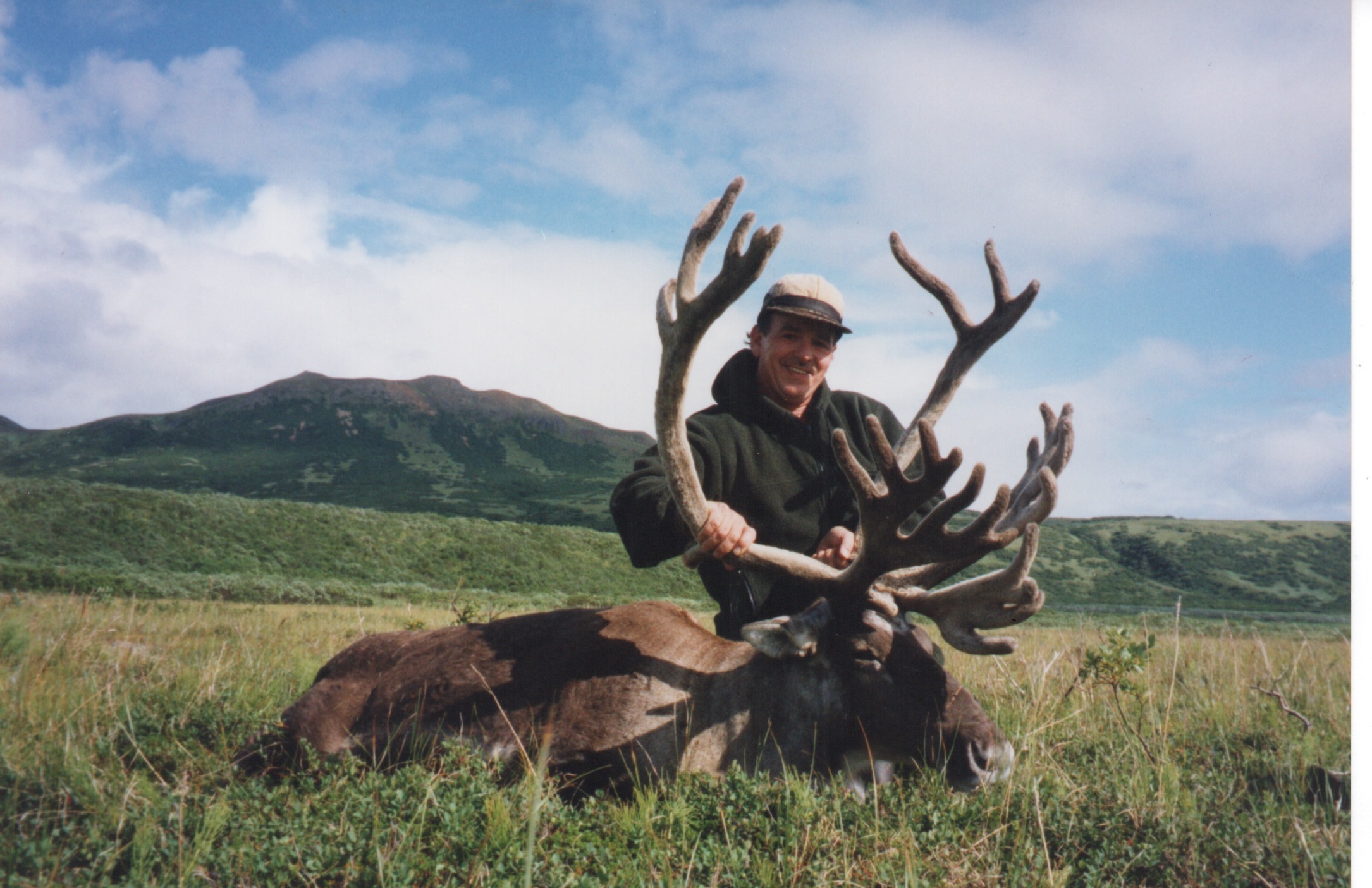
I don’t know how long I napped but when I got up, there was lo and behold, a very nice bull caribou slowly crossing the plain below us. As carefully as possible, I shook Jim and pointed to the bottom of the hill. We grabbed our rifles and, using the short alders that grew on the top of the hill as cover, paralleled the bull’s direction. We got to the end of the hill’s crest, looked down and saw no caribou! We glassed for about fifteen minutes, and then Jim picked him out in a low stand of alders at the other side of the valley, scratching the velvet from his antlers. Having no shot from where we stood, we decided to use the hill as cover to move behind the bull and then get up above him on the opposite hillside. After what seemed to take an eternity, we were in position. I stood up to aim, slipped the safety off, shifted my weight and flushed a ptarmigan! The noise, of course, got the bull’s attention. He looked up at where we were standing, nervously stepped out a bit, and I squeezed the trigger. The.210 grain Nosler Partition® took him right thought the center of his left shoulder. He went about 175 yards in a straight line before he fell. As we caped him out, I found the bullet just below the skin on his right hip. That was the last time I used light bullets in the .338.
On the next morning, we packed the shotgun, rods, flies and enough food for lunch and made the three-hour hike to the Meshik River. On the way, we flushed and shot a few ptarmigan, which we cleaned and packed for that evening’s dinner. The Meshick is a true wilderness river, with virtually no access except by foot or plane. From the first cast, I knew it would be a special experience. Hungry Dolly Vardens would chase and attack my offerings, often two at a time. Small fish were 20 inches, and I landed and released over 50 fish. I caught one Arctic Char that measured 30 inches and a small silver salmon before Jim interrupted. He told me that I was only going to keep catching those small fish if I didn’t put on a larger fly. I was happy with what I was catching but tied on a 1/0 purple and white lefty’s deceiver and cast into a deep, heavy current on the other side of the river. On the third cast, a salmon hit so hard it nearly tore the rod from my hand. I don’t think I’d ever been into my backing so quickly. The 10-weight rod did its job, and I had the fish ashore after what seeded to be one or two lifetimes. Jim estimated it to be around fifteen pounds. We released it, and I kept on fishing.
We quit around 6:00 PM, as we had a three hour hike back, and it got dark around 9:30 PM (We’re in Alaska, remember). As I put my stuff back into the frame pack, Jim asked once again, “Want to see a bear?” I turned around to see a medium sized brown bear standing upright on the opposite shore. It looked to be about six or seven feet tall from where I stood. Jim explained that it was a small sow, and we probably invaded her fishing spot. It really was time to go.
It rained so hard the next day that visibility was cut to about five feet. The plane obviously didn’t show up and we had one more night in camp. I wouldn’t return to Alaska for nine years, but the next time I’d be after the bears, instead of thinking they were after me.

