.png)


.jpg)
.jpg)
.jpg)

By Craig Boddington
Most American hunters over 50 grew up reading Jack O’Connor. In 1973, O’Connor’s retirement from Outdoor Life cemented Bob Petersen’s decision to start this magazine. I was delighted with the first-ever magazine devoted strictly to hunting, delivering feature-length O’Connor adventures every month. The Professor contributed to every issue until his death in 1978, gracing these pages with 50+ great O’Connor stories, many on the wild sheep he loved to hunt.
It wasn’t O’Connor, but New York advertising executive, Grancel Fitz who borrowed a baseball term for the feat of taking one each of the four North American wild sheep, penning a 1948 True article “Grand Slam in Rams.” O’Connor’s writing did much to popularize the challenge. Late in life he came to regret this bitterly, believing too many hunters were on the mountain for ego or status, not for love of the game.
Good or bad, over the last 70 years many hunters have dreamed of taking our four North American wild sheep. I am among them, almost doomed from the start. In the 1930s, my uncle, Art Popham, attended the University of Arizona, where Jack O’Connor was his English professor. I didn’t know O’Connor well, but he was a family friend, and godfather to a cousin.
In August 1935, Art and O’Connor ventured into Sonora to hunt desert sheep–the first sheep hunt for both of them. Art was successful, O’Connor was not, but they both became hooked and would go on to do a lot more sheep hunting. I was still in grade school when Uncle Art took his final North American ram, a Stone sheep from British Columbia.
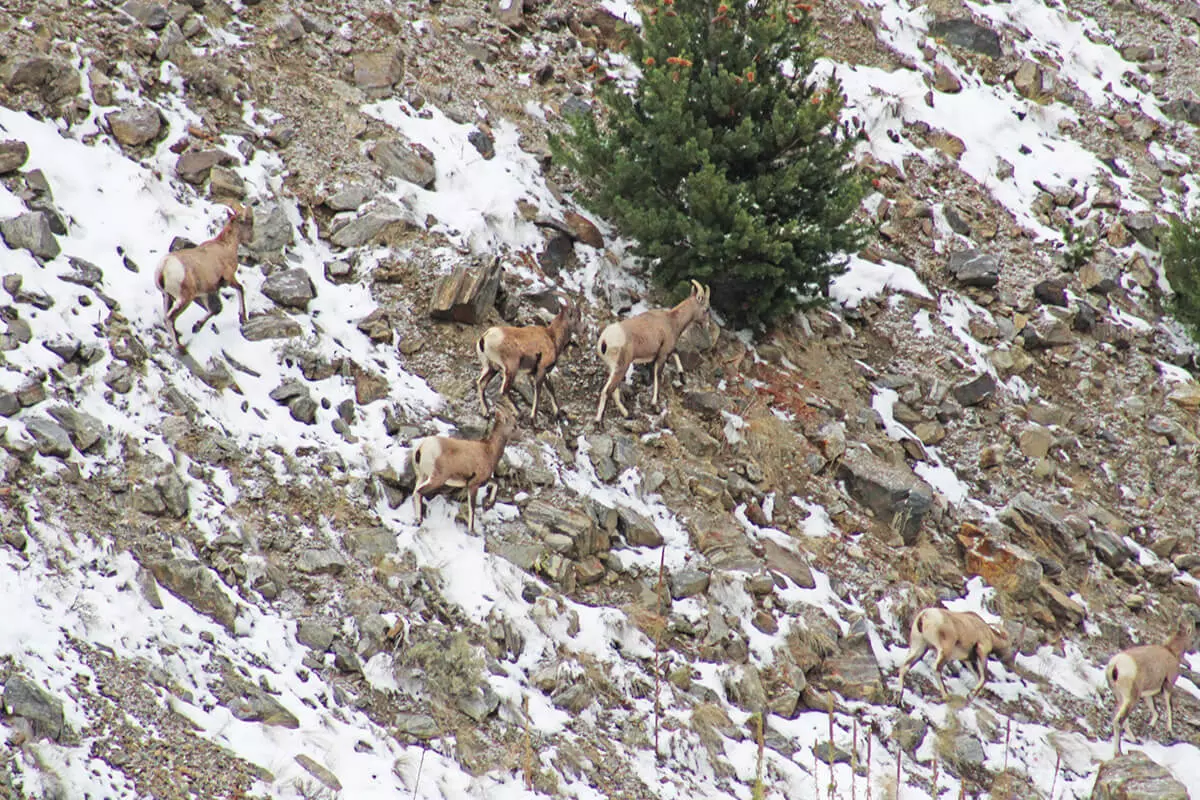
So, you can understand that I considered it the natural order of things, almost a birthright, that I would someday hunt all four of our sheep. I had no idea how difficult the quest would become. Eventually, I got it done (and did it again a second time). Timing is everything. I have seen prices skyrocket, but I got into this stuff before that happened. Also, I had some luck: I have drawn three great sheep tags. Again, timing: I got into the drawings in several states at the start of their preference or bonus points, almost ensuring I would eventually draw.
The point systems are mostly mature now. If a person started applying today, it would take unimaginable luck to draw multiple tags. That said, I believe in our permit drawings. I urge people (especially younger people) to apply, stay in the draws and have faith. A drawn permit is the best key to an affordable sheep hunt.
In many situations, you can hunt DIY. I’ve done that and got a nice ram. It depends on you, and your proximity to the hunt area for scouting). These days, draw a tag and the people will come; tagholders are amazed at the offers of assistance in scouting, glassing, even packing. Alternatively, it’s far from dumb to find a great outfitter who knows the area. With tag in hand, guided sheep hunts are not expensive, usually less than medium elk hunts. Just remember: A sheep tag is a once-in-a-lifetime opportunity. Failure is unthinkable, so give it your best shot!

My mountain hunts have been mostly charmed, with a few failures. I was due. Donna wanted “just one sheep,” and I wanted a Dall ram from the far north Brooks Range. We booked a two-by-two hunt in 2016. Weathered out completely, we never saw the mountain tops. We went back separately in alternate years and both got nice rams, but the real math was “two rams for the price of four.” I’m not a gloom and doom guy, but I want to be realistic. Dall sheep hunts are still the least costly, but prices have gone up a lot since 2016, some outfitters nearly double.
Put it all together, and taking one each of all four North American wild sheep is no longer a sensible or realistic goal. I think many folks have seen this writing on the wall. This past convention season, I had several folks approach me, saying they’d never hunted a wild sheep, and wanted to sample the experience, maybe just once.
Now that’s a more sensible goal! A sheep hunt is hard work and can bring heartbreak and misery. But can be, should be, and usually is a magical experience. As a warning, it’s terribly addictive, but attack it one at a time. It really doesn’t matter if you continue to other mountains, or stop at that one.

Our “collection” of four North American wild sheep is a made-up grouping that, viewed scientifically, doesn’t make complete sense. Traditionally, we include Dall, Stone, Rocky Mountain bighorn, and desert bighorn. There are two schools of taxonomy: Lumpers and splitters. Splitters want as many categories (species, subspecies, races) as possible; lumpers put them together wherever practical.
With our sheep, both groups pitched in. We actually have only two species of North American wild sheep: Thinhorns (Ovis dalli); and bighorns (Ovis canadensis). The lumpers won this round. The dark Stone sheep of northern B.C. is a subspecies of the pure white Dall. Southern Yukon has dark sheep, but usually not as dark. These sheep are a grab-bag, from dark, to salt-and-pepper with white faces and neck, to almost white. All variations may be seen within a single band. They are often called Fannin sheep, but are a natural hybrid between a Dall and Stone. Back when Stone sheep were more available and less costly, Yukon outfitters with Fannin sheep could barely give their hunts away. Today, we mostly call them “Stone sheep,” priced much the same as B.C. hunts.
The Rocky Mountain bighorn is our largest bodied sheep with the heaviest horns. Off to the west, from the Sierra Nevada north into west-central B.C., is the slightly smaller California bighorn. Most organizations, including Boone and Crockett, lump them, but SCI and Grand Slam Club/Ovis recognize the California bighorn.
The desert bighorns are more confusing. They are a smaller-bodied dry land adaptation and are a subspecies of the Rocky Mountain bighorn. The Baja Peninsula has two races: One north (the largest) and one south (the smallest). The mexicana race is found on the mainland of northern Mexico, tipping into southwestern US. North of that is Nelson’s bighorn (nelsoni). Few among us could tell them apart, but there are differences in typical horn configuration. Obviously, the lumpers consider there is one desert bighorn while the splitters separate them. If you’re a splitter, you might consider that we have nine North American wild sheep: Dall, Stone, Fannin, Rocky Mountain and California bighorn, plus the four desert races. Thank God, nobody ever convinced me I should hunt all nine!
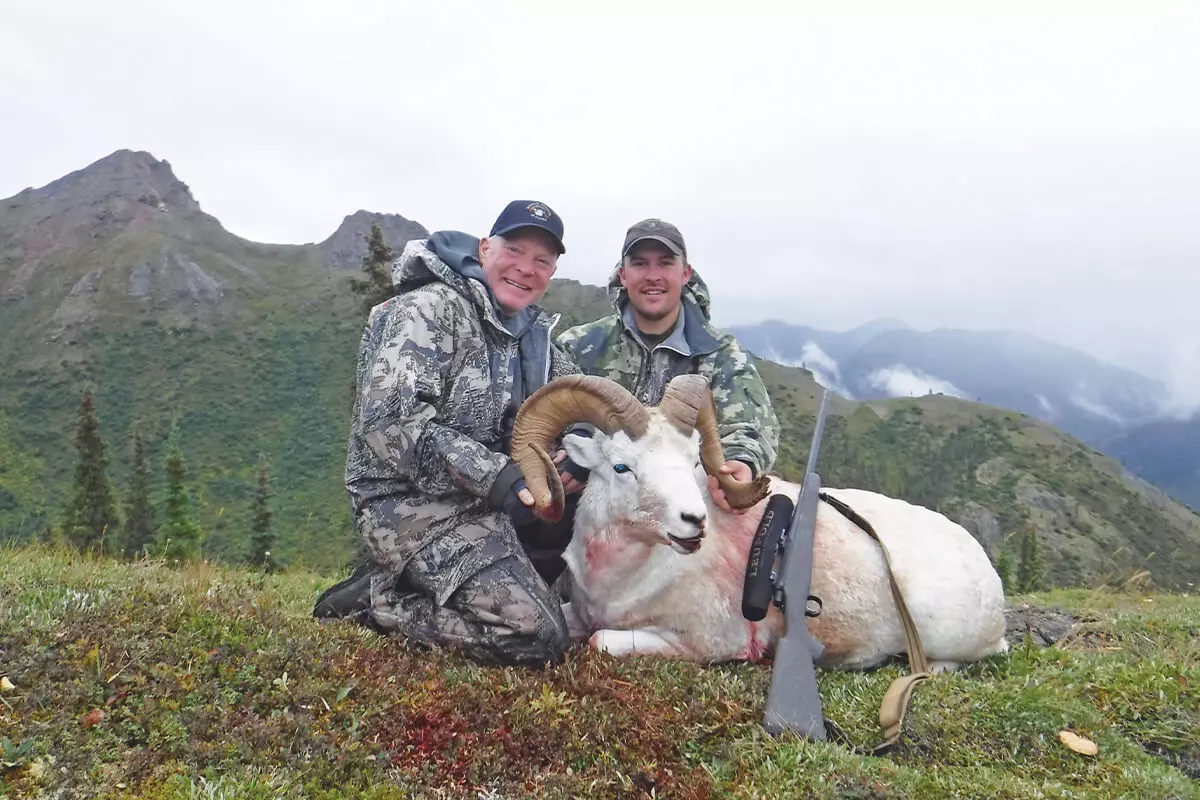
Before WWII, Alaska and northwestern Canada were nearly inaccessible. Packstring hunts lasting 30 days were minimal, with many more days spent travelling. Alaska was reachable only by ship. In those days, most Lower 48 sheep populations were small remnants. The desert bighorns O’Connor and Uncle Art “discovered” in Sonora were the most available and accessible of our wild sheep. Northern Mexico was wild and lawless country so let’s be honest: That hunting was a little bit gray.
After the war, passenger air expedited access to Alaska and northwest Canada and light aircraft (Super Cubs) reduced days (and effort) needed to access sheep country. For a time, bighorns in the Alberta Rockies were our most available sheep. Through the Fifties, pioneer outfitters established territories in Alaska, B.C., and the Yukon for both dark and white sheep.
In August 1973, Dad and I followed Jack and Eleanor O’Connor into old Frank Cook’s Scoop Lake base camp in northern B.C.’s Cassiars. That was O’Connor’s next-to-last sheep hunt; of course, my first. At that time, the Stone sheep was our most available, accessible and inexpensive wild sheep. Sheep numbers were high, resident pressure was nil, and the outfitters had no established quota. Good air service ran from Vancouver to Watson Lake, Yukon; B.C.’s Stone sheep country was just a short charter south.
Within two years, nonresident sheep quotas were established. Suddenly, outfitters had to make the same living from decreasing numbers of hunts. Naturally, prices started to climb. Remember, too, that the Stone subspecies has one of the smallest ranges of any of the world’s wild sheep, limited to northern B.C. and just a couple of guide territories in the Yukon. In spite of sharply limited nonresident harvest, resident pressure has continued to increase, as has predation. Stone sheep numbers have slowly declined. The outfitting industry is a classic supply and demand business. No surprise that prices have continued to climb.
Since the 1970s, Dall sheep hunts have been the most available and least expensive, though prices are continually climbing. This has not changed. However, thanks to Mexico’s “UMA” system of privatized management units (instituted in the late 90s and requiring demonstrable habitat improvement), her desert sheep have flourished with more permits becoming available every year. This is also supply and demand. There are about as many desert sheep permits as can be sold. Prices remain high, but are stable or decreasing slightly.

Well, that depends on you. Age, condition, and budget; and whether you’re truly looking for the experience or fixated on a big ram. If the latter, God help you! If you want the experience, any sheep hunt is wonderful, just accept that not all hunts are successful and not everybody who tags a sheep will get a monster.
There are no cheap sheep hunts but get into the drawings—as many as you can afford—and keep applying. Lightning does strike; some permits go to first-time applicants.
Are you aware of Montana’s “unlimited bighorn zones?” There are five, with quotas of two rams each. Permits are unlimited, to be applied for by drawing deadline. Areas are closed (on 48-hour notice) when the quota is filled. These areas are not unlimited because they hold lots of sheep or giant rams. Generally, they are high and rough. Success is low and big rams are scarce; Montana sheep hunters appreciate that “any legal ram” from an unlimited zone is a trophy.
The unlimited zones can be hunted DIY, which appeals to many. Although success remains low, several Montana outfitters hunt unlimited zones and charge little. In 2020, I drew a Montana goat tag and hunted with Ryan Counts (Dome Mountain Ranch). Ryan is a good young horse outfitter; I liked him. Just in the last few years, Donna has gotten an itch to hunt sheep. Ryan Counts does unlimited sheep, so I booked a ’21 hunt for her. When I got home, I told her “Here’s the deal, it’s too late for you to start applying for tags, and we sure aren’t buying auction permits. You probably won’t get a ram, but it’s okay if we need to go a few times. Oh, and by the way, if we see a legal ram, you should take it!”
The unlimited zones can be hunted DIY, which appeals to many. Although success remains low, several Montana outfitters hunt unlimited zones and charge little. In 2020, I drew a Montana goat tag and hunted with Ryan Counts (Dome Mountain Ranch). Ryan is a good young horse outfitter; I liked him. Just in the last few years, Donna has gotten an itch to hunt sheep. Ryan Counts does unlimited sheep, so I booked a ’21 hunt for her. When I got home, I told her “Here’s the deal, it’s too late for you to start applying for tags, and we sure aren’t buying auction permits. You probably won’t get a ram, but it’s okay if we need to go a few times. Oh, and by the way, if we see a legal ram, you should take it!”
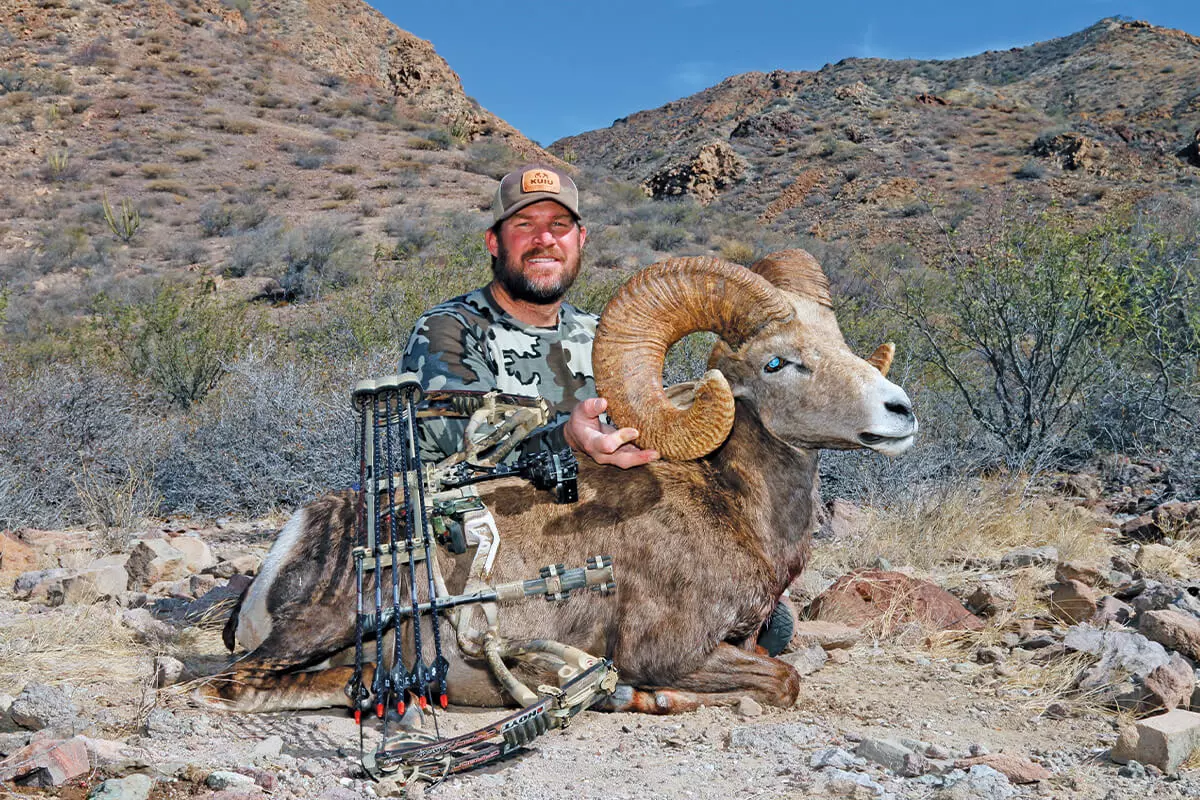
Fast forward to autumn ’21. One of my colleagues, younger and in better shape, packed into an unlimited zone, hunted hard for ten days, and never saw a sheep. That can happen; it’s tough country to “go in cold.” A few days later, we did our hunt with Ryan Counts, who lives nearby and knows the area. We glassed sheep daily and saw eight or nine sub-legal rams. It was already an awesome experience. It got better on our fourth day when Donna beat the odds and shot a three-quarter curl ram. Definitely not huge, but a bighorn for less than the cost of a basic elk hunt.
Unfortunately, failing drawing a tag (or enormous luck like Donna’s), to experience a sheep hunt you will need to pony up for an outfitted hunt. Which sheep? I think a dark Stone ram is the world’s prettiest sheep and their northern B.C./southern Yukon habitat is gorgeous. The country isn’t all that tough but, even at the price, success is not assured and I think the cost is just too high. I rule out bighorns as well. Generally tougher hunting, also very costly, and success is iffy.
For 40 years, my answer to “just one sheep” or a first sheep hunt has been a Dall sheep, your choice of Alaska, Yukon, or NWT. Still is, but I’m assuming you’re in shape for a really tough hunt and able to handle disappointment. Horseback hunts are usually costlier than backpack-based, but possibly more successful because more ground can be covered. However, some hunts will be defeated by weather, and far north sheep populations fluctuate. Hunts are usually planned a couple years out, so you can’t know what Old Man Winter might bring.
The standard answer remains Dall sheep, but let me bounce an oddball alternative: Give at least passing thought to a desert ram in Mexico; like O’Connor and Uncle Art started with 87 years ago. More expensive, yes, but the gap is narrowing. With numbers and quality way up, almost all hunts are successful; which cannot be said of any of our other sheep. The desert mountains are uniquely beautiful. Plenty steep and footing crumbly and treacherous but there is little elevation. For those uncertain about their physical ability to handle a mountain hunt, hunting desert bighorns today is by far the easiest of all North American sheep hunting. And sheep camp on a remote ranch in rural Mexico is a matchless experience.
At the convention season just past, I actually proposed Mexico to a couple of guys who asked the “just one sheep” question. They looked at me like I had three heads until I explained: Success, experience, ambience, likelihood of looking over a number of rams. Most will start with Dall sheep but that isn’t locked in stone. In January ’21, my son-in-law, Brad Jannenga, did his first sheep hunt. He’s young and in plenty good shape, also an experienced hunter but, like many, he just hadn’t gotten around to sheep. His first was a desert bighorn, on Carmen Island off Baja. Great experience, wonderful hunt, awesome ram. Can’t yet say for sure, but I doubt he’ll hold himself to “just one sheep.”
By Craig Boddington
Most American hunters over 50 grew up reading Jack O’Connor. In 1973, O’Connor’s retirement from Outdoor Life cemented Bob Petersen’s decision to start this magazine. I was delighted with the first-ever magazine devoted strictly to hunting, delivering feature-length O’Connor adventures every month. The Professor contributed to every issue until his death in 1978, gracing these pages with 50+ great O’Connor stories, many on the wild sheep he loved to hunt.
It wasn’t O’Connor, but New York advertising executive, Grancel Fitz who borrowed a baseball term for the feat of taking one each of the four North American wild sheep, penning a 1948 True article “Grand Slam in Rams.” O’Connor’s writing did much to popularize the challenge. Late in life he came to regret this bitterly, believing too many hunters were on the mountain for ego or status, not for love of the game.
Good or bad, over the last 70 years many hunters have dreamed of taking our four North American wild sheep. I am among them, almost doomed from the start. In the 1930s, my uncle, Art Popham, attended the University of Arizona, where Jack O’Connor was his English professor. I didn’t know O’Connor well, but he was a family friend, and godfather to a cousin.
In August 1935, Art and O’Connor ventured into Sonora to hunt desert sheep–the first sheep hunt for both of them. Art was successful, O’Connor was not, but they both became hooked and would go on to do a lot more sheep hunting. I was still in grade school when Uncle Art took his final North American ram, a Stone sheep from British Columbia.
So, you can understand that I considered it the natural order of things, almost a birthright, that I would someday hunt all four of our sheep. I had no idea how difficult the quest would become. Eventually, I got it done (and did it again a second time). Timing is everything. I have seen prices skyrocket, but I got into this stuff before that happened. Also, I had some luck: I have drawn three great sheep tags. Again, timing: I got into the drawings in several states at the start of their preference or bonus points, almost ensuring I would eventually draw.
The point systems are mostly mature now. If a person started applying today, it would take unimaginable luck to draw multiple tags. That said, I believe in our permit drawings. I urge people (especially younger people) to apply, stay in the draws and have faith. A drawn permit is the best key to an affordable sheep hunt.
In many situations, you can hunt DIY. I’ve done that and got a nice ram. It depends on you, and your proximity to the hunt area for scouting). These days, draw a tag and the people will come; tagholders are amazed at the offers of assistance in scouting, glassing, even packing. Alternatively, it’s far from dumb to find a great outfitter who knows the area. With tag in hand, guided sheep hunts are not expensive, usually less than medium elk hunts. Just remember: A sheep tag is a once-in-a-lifetime opportunity. Failure is unthinkable, so give it your best shot!
My mountain hunts have been mostly charmed, with a few failures. I was due. Donna wanted “just one sheep,” and I wanted a Dall ram from the far north Brooks Range. We booked a two-by-two hunt in 2016. Weathered out completely, we never saw the mountain tops. We went back separately in alternate years and both got nice rams, but the real math was “two rams for the price of four.” I’m not a gloom and doom guy, but I want to be realistic. Dall sheep hunts are still the least costly, but prices have gone up a lot since 2016, some outfitters nearly double.
Put it all together, and taking one each of all four North American wild sheep is no longer a sensible or realistic goal. I think many folks have seen this writing on the wall. This past convention season, I had several folks approach me, saying they’d never hunted a wild sheep, and wanted to sample the experience, maybe just once.
Now that’s a more sensible goal! A sheep hunt is hard work and can bring heartbreak and misery. But can be, should be, and usually is a magical experience. As a warning, it’s terribly addictive, but attack it one at a time. It really doesn’t matter if you continue to other mountains, or stop at that one.
Our “collection” of four North American wild sheep is a made-up grouping that, viewed scientifically, doesn’t make complete sense. Traditionally, we include Dall, Stone, Rocky Mountain bighorn, and desert bighorn. There are two schools of taxonomy: Lumpers and splitters. Splitters want as many categories (species, subspecies, races) as possible; lumpers put them together wherever practical.
With our sheep, both groups pitched in. We actually have only two species of North American wild sheep: Thinhorns (Ovis dalli); and bighorns (Ovis canadensis). The lumpers won this round. The dark Stone sheep of northern B.C. is a subspecies of the pure white Dall. Southern Yukon has dark sheep, but usually not as dark. These sheep are a grab-bag, from dark, to salt-and-pepper with white faces and neck, to almost white. All variations may be seen within a single band. They are often called Fannin sheep, but are a natural hybrid between a Dall and Stone. Back when Stone sheep were more available and less costly, Yukon outfitters with Fannin sheep could barely give their hunts away. Today, we mostly call them “Stone sheep,” priced much the same as B.C. hunts.
The Rocky Mountain bighorn is our largest bodied sheep with the heaviest horns. Off to the west, from the Sierra Nevada north into west-central B.C., is the slightly smaller California bighorn. Most organizations, including Boone and Crockett, lump them, but SCI and Grand Slam Club/Ovis recognize the California bighorn.
The desert bighorns are more confusing. They are a smaller-bodied dry land adaptation and are a subspecies of the Rocky Mountain bighorn. The Baja Peninsula has two races: One north (the largest) and one south (the smallest). The mexicana race is found on the mainland of northern Mexico, tipping into southwestern US. North of that is Nelson’s bighorn (nelsoni). Few among us could tell them apart, but there are differences in typical horn configuration. Obviously, the lumpers consider there is one desert bighorn while the splitters separate them. If you’re a splitter, you might consider that we have nine North American wild sheep: Dall, Stone, Fannin, Rocky Mountain and California bighorn, plus the four desert races. Thank God, nobody ever convinced me I should hunt all nine!
Before WWII, Alaska and northwestern Canada were nearly inaccessible. Packstring hunts lasting 30 days were minimal, with many more days spent travelling. Alaska was reachable only by ship. In those days, most Lower 48 sheep populations were small remnants. The desert bighorns O’Connor and Uncle Art “discovered” in Sonora were the most available and accessible of our wild sheep. Northern Mexico was wild and lawless country so let’s be honest: That hunting was a little bit gray.
After the war, passenger air expedited access to Alaska and northwest Canada and light aircraft (Super Cubs) reduced days (and effort) needed to access sheep country. For a time, bighorns in the Alberta Rockies were our most available sheep. Through the Fifties, pioneer outfitters established territories in Alaska, B.C., and the Yukon for both dark and white sheep.
In August 1973, Dad and I followed Jack and Eleanor O’Connor into old Frank Cook’s Scoop Lake base camp in northern B.C.’s Cassiars. That was O’Connor’s next-to-last sheep hunt; of course, my first. At that time, the Stone sheep was our most available, accessible and inexpensive wild sheep. Sheep numbers were high, resident pressure was nil, and the outfitters had no established quota. Good air service ran from Vancouver to Watson Lake, Yukon; B.C.’s Stone sheep country was just a short charter south.
Within two years, nonresident sheep quotas were established. Suddenly, outfitters had to make the same living from decreasing numbers of hunts. Naturally, prices started to climb. Remember, too, that the Stone subspecies has one of the smallest ranges of any of the world’s wild sheep, limited to northern B.C. and just a couple of guide territories in the Yukon. In spite of sharply limited nonresident harvest, resident pressure has continued to increase, as has predation. Stone sheep numbers have slowly declined. The outfitting industry is a classic supply and demand business. No surprise that prices have continued to climb.
Since the 1970s, Dall sheep hunts have been the most available and least expensive, though prices are continually climbing. This has not changed. However, thanks to Mexico’s “UMA” system of privatized management units (instituted in the late 90s and requiring demonstrable habitat improvement), her desert sheep have flourished with more permits becoming available every year. This is also supply and demand. There are about as many desert sheep permits as can be sold. Prices remain high, but are stable or decreasing slightly.
Well, that depends on you. Age, condition, and budget; and whether you’re truly looking for the experience or fixated on a big ram. If the latter, God help you! If you want the experience, any sheep hunt is wonderful, just accept that not all hunts are successful and not everybody who tags a sheep will get a monster.
There are no cheap sheep hunts but get into the drawings—as many as you can afford—and keep applying. Lightning does strike; some permits go to first-time applicants.
Are you aware of Montana’s “unlimited bighorn zones?” There are five, with quotas of two rams each. Permits are unlimited, to be applied for by drawing deadline. Areas are closed (on 48-hour notice) when the quota is filled. These areas are not unlimited because they hold lots of sheep or giant rams. Generally, they are high and rough. Success is low and big rams are scarce; Montana sheep hunters appreciate that “any legal ram” from an unlimited zone is a trophy.
The unlimited zones can be hunted DIY, which appeals to many. Although success remains low, several Montana outfitters hunt unlimited zones and charge little. In 2020, I drew a Montana goat tag and hunted with Ryan Counts (Dome Mountain Ranch). Ryan is a good young horse outfitter; I liked him. Just in the last few years, Donna has gotten an itch to hunt sheep. Ryan Counts does unlimited sheep, so I booked a ’21 hunt for her. When I got home, I told her “Here’s the deal, it’s too late for you to start applying for tags, and we sure aren’t buying auction permits. You probably won’t get a ram, but it’s okay if we need to go a few times. Oh, and by the way, if we see a legal ram, you should take it!”
The unlimited zones can be hunted DIY, which appeals to many. Although success remains low, several Montana outfitters hunt unlimited zones and charge little. In 2020, I drew a Montana goat tag and hunted with Ryan Counts (Dome Mountain Ranch). Ryan is a good young horse outfitter; I liked him. Just in the last few years, Donna has gotten an itch to hunt sheep. Ryan Counts does unlimited sheep, so I booked a ’21 hunt for her. When I got home, I told her “Here’s the deal, it’s too late for you to start applying for tags, and we sure aren’t buying auction permits. You probably won’t get a ram, but it’s okay if we need to go a few times. Oh, and by the way, if we see a legal ram, you should take it!”
Fast forward to autumn ’21. One of my colleagues, younger and in better shape, packed into an unlimited zone, hunted hard for ten days, and never saw a sheep. That can happen; it’s tough country to “go in cold.” A few days later, we did our hunt with Ryan Counts, who lives nearby and knows the area. We glassed sheep daily and saw eight or nine sub-legal rams. It was already an awesome experience. It got better on our fourth day when Donna beat the odds and shot a three-quarter curl ram. Definitely not huge, but a bighorn for less than the cost of a basic elk hunt.
Unfortunately, failing drawing a tag (or enormous luck like Donna’s), to experience a sheep hunt you will need to pony up for an outfitted hunt. Which sheep? I think a dark Stone ram is the world’s prettiest sheep and their northern B.C./southern Yukon habitat is gorgeous. The country isn’t all that tough but, even at the price, success is not assured and I think the cost is just too high. I rule out bighorns as well. Generally tougher hunting, also very costly, and success is iffy.
For 40 years, my answer to “just one sheep” or a first sheep hunt has been a Dall sheep, your choice of Alaska, Yukon, or NWT. Still is, but I’m assuming you’re in shape for a really tough hunt and able to handle disappointment. Horseback hunts are usually costlier than backpack-based, but possibly more successful because more ground can be covered. However, some hunts will be defeated by weather, and far north sheep populations fluctuate. Hunts are usually planned a couple years out, so you can’t know what Old Man Winter might bring.
The standard answer remains Dall sheep, but let me bounce an oddball alternative: Give at least passing thought to a desert ram in Mexico; like O’Connor and Uncle Art started with 87 years ago. More expensive, yes, but the gap is narrowing. With numbers and quality way up, almost all hunts are successful; which cannot be said of any of our other sheep. The desert mountains are uniquely beautiful. Plenty steep and footing crumbly and treacherous but there is little elevation. For those uncertain about their physical ability to handle a mountain hunt, hunting desert bighorns today is by far the easiest of all North American sheep hunting. And sheep camp on a remote ranch in rural Mexico is a matchless experience.
At the convention season just past, I actually proposed Mexico to a couple of guys who asked the “just one sheep” question. They looked at me like I had three heads until I explained: Success, experience, ambience, likelihood of looking over a number of rams. Most will start with Dall sheep but that isn’t locked in stone. In January ’21, my son-in-law, Brad Jannenga, did his first sheep hunt. He’s young and in plenty good shape, also an experienced hunter but, like many, he just hadn’t gotten around to sheep. His first was a desert bighorn, on Carmen Island off Baja. Great experience, wonderful hunt, awesome ram. Can’t yet say for sure, but I doubt he’ll hold himself to “just one sheep.”
Over the past 40 years, Craig Boddington traveled to 56 countries to hunt about 300 species with several hundred outfitters - over 110 hunts in Africa alone. From Kyrgyzstan to Kansas, Mozambique to Montana, no other hunter is more qualified to identify a good outfitter.
FIND YOUR OUTFITTER


Let Us Know What You Think!
Comments